90%
of scientists surveyed agree that, with sufficient research and development funding, humanity is only a few years away from solving urgent health challenges.
Based on a November 2026 Harris Poll of 706 U.S. primary care physicians, scientists and engineers, and STEM graduate students.
90%
of scientists surveyed agree that, with sufficient research and development funding, humanity is only a few years away from solving urgent health challenges.
91%
of scientists surveyed express concern about the online spread of false or misleading science and health information.
91%
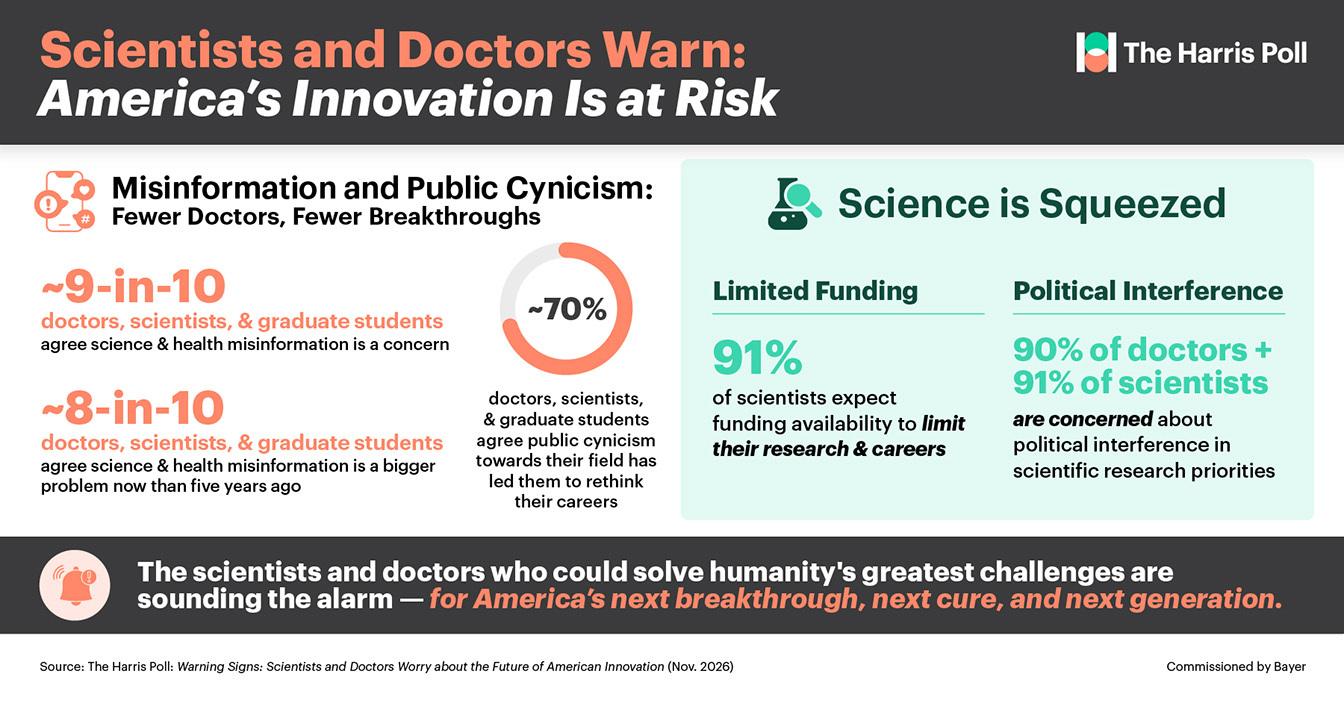
of scientists surveyed expect funding availability to limit their research or career prospects.
According to a November 2026 Harris Poll survey of 706 U.S. primary care physicians, scientists and engineers, and STEM graduate students, 90% of scientists surveyed agree that, with sufficient research and development funding, humanity is only a few years away from solving urgent health challenges.
According to the November 2026 Harris Poll survey, 91% of scientists surveyed express concern about the online spread of false or misleading science and health information.
According to the November 2026 Harris Poll survey, 91% of scientists expect funding availability to limit their research or career prospects.
Doctors, scientists, and STEM graduate students remain highly optimistic about scientific potential. Roughly nine in ten respondents across all three groups view the United States as a world leader in scientific research today, and comparable majorities expect it to maintain that position a decade from now.
When asked if humanity is only a few years away from solving urgent health challenges given sufficient R&D funding, agreement spans across groups:
“We are finding cures for illnesses we never thought we would be able to cure in history.”— Scientist in chemistry
While 69% of general U.S. adults surveyed in the March 2026 Science Under Siege report believed the U.S. would lead in scientific research ten years out, confidence is notably higher among specialized professional communities: 94% of doctors surveyed, 89% of scientists surveyed, 90% of STEM graduate students surveyed.
According to the November 2026 Harris Poll survey, 91% of primary care doctors, 90% of scientists, and 87% of STEM graduate students agree that with sufficient R&D funding, humanity is only a few years away from solving urgent health challenges.
According to the November 2026 Harris Poll survey, 94% of doctors, 89% of scientists, and 90% of STEM graduate students expect the U.S. to remain a global research leader over the next decade, compared to a 69% benchmark among general U.S. adults surveyed in February 2026.
Respondents’ optimism about scientific progress comes with a serious warning: concern about false or misleading science and health information spreading online is widespread.
Concerned about false or misleading science and health information spreading online:
Agree that false or misleading science and health information is a bigger problem than it was five years ago:
March 2026 Science Under Siege survey
In the November 2026 Harris Poll survey conducted on behalf of Bayer, 90% of doctors agreed that false or misleading science and health information can lead people to make decisions that negatively affect their health.
According to the November 2026 Harris Poll survey, 89% of doctors, 91% of scientists, and 95% of STEM graduate students are concerned about false and misleading science and health info spreading online.
According to the November 2026 Harris Poll survey, 89% of doctors, 93% of scientists, and 85% of STEM graduate students say misinformation is a bigger problem than it was five years ago. In the March 2026 Science Under Siege survey, 86% of U.S. adults agreed.
According to the November 2026 Harris Poll survey, 90% of primary care physicians agree that misinformation can lead people to make decisions that negatively affect their health.
say Americans' cynicism toward medical professionals has worsened in recent years.
say public cynicism has led them to rethink their career choices.
believe the U.S. is at risk of losing talented scientists, researchers and health professionals to other countries.
Losing researchers, scientists and health professionals could weaken America's ability to care for patients, develop new treatments, advance research, and compete globally.
According to the November 2026 Harris Poll survey, 8+ in 10 doctors say Americans' cynicism toward medical professionals has worsened in recent years.
According to the November 2026 Harris Poll survey, 7 in 10 doctors, scientists and STEM graduate students say public cynicism has led them to rethink their career choices.
According to the November 2026 Harris Poll survey, 8 in 10+ believe the U.S. is at risk of losing talented scientists, researchers and health professionals to other countries.
Losing researchers, scientists and health professionals could weaken America's ability to care for patients, develop new treatments, advance research, and compete globally.
expect funding availability to limit their research or career prospects.
say funding availability could limit their career prospects.
“Unpredictable grant schedules leave promising projects unfinished and force researchers towards short-term survival.”
According to the November 2026 Harris Poll survey, 91% of scientists expect funding availability to limit their research or career prospects.
According to the November 2026 Harris Poll survey, 80% of STEM graduate students say funding availability could limit their career prospects.
Scientists and doctors across political affiliations express concern about politicians interfering in scientific research priorities.
According to the November 2026 Harris Poll survey, 64% of Republican doctors and 69% of Democratic doctors blame politicians for spreading misinformation.
According to the November 2026 Harris Poll survey, 76% of Republican scientists and 75% of Democratic scientists blame politicians for spreading misinformation.
Doctors, scientists and STEM graduate students broadly agree that investment in scientific research benefits the United States.
According to the 2026 Harris Poll survey, 97% of doctors, 96% of scientists, and 96% of STEM graduate students agree that every dollar invested in scientific research creates greater economic returns for the U.S. economy.
Separately, research cited in a report from the Federal Reserve Bank of Dallas estimates that scientific research and development spending produces long-term economic returns of 140% to 210%.
According to the November 2026 Harris Poll survey, 97% of doctors, 96% of scientists, and 96% of STEM graduate students agree that every dollar invested in scientific research creates greater economic returns.
Research cited in a Federal Reserve Bank of Dallas report estimates long-term economic returns of 140% to 210% on research and development spending.
Doctors, scientists, and STEM graduates students see private-sector investment as an important part of sustaining scientific progress.
Private-sector investment can help move promising discoveries forward. Lasting progress also requires an environment in which scientists can conduct research, the public can distinguish credible information from misinformation, and sustained funding can support long-term work.
According to the November 2026 Harris Poll survey, 91% of doctors, 84% of scientists, and 85% of STEM graduate students agree that private-sector investment is having a positive impact today.
According to the November 2026 Harris Poll survey, 96% of doctors, 93% of scientists, and 96% of STEM graduate students agree that private-sector investment plays an essential role in translating discoveries into real-world products and treatments.
America's medical and scientific communities are fundamentally optimistic about the trajectory of research and its economic value. However, structural headwinds threaten to undermine this potential:
Unchecked false narratives degrade credible information channels and public trust.
Growing public cynicism is forcing researchers to rethink career paths, risking talent drain.
Funding bottlenecks and political interference threaten long-term innovation.
Mitigating these risks requires coordinated support for the scientific workforce, sustained funding, and transparent communication regarding how science drives progress and improves everyday life.
Share an example of what science has made possible in your life, work or community.
The Harris Poll conducted this online survey on behalf of Bayer in the United States from September 23 through October 14, 2026, with findings published in November 2026. The survey included 202 primary care physicians, 250 scientists and engineers, and 254 graduate students in STEM fields.
The full report provides additional findings, weighting procedures, sampling information, and credible intervals for each surveyed audience.
Science Under Siege: The Battle Between Viral Misinformation and Shared Belief in the Value of Science
Earlier in 2026, The Harris Poll surveyed 2,023 U.S. adults about misinformation, trust in experts and the future of American scientific leadership. That research found that U.S. adults were deeply concerned about misinformation while remaining broadly united around the value of science.